AUTONOMOUS · VERIFIED · DEPLOYABLEFIG. 01 — A SIGNED WATER RECORD
PLEIONE WATER · EST. 2026
01 Autonomous water infrastructure
Water thatruns itself.
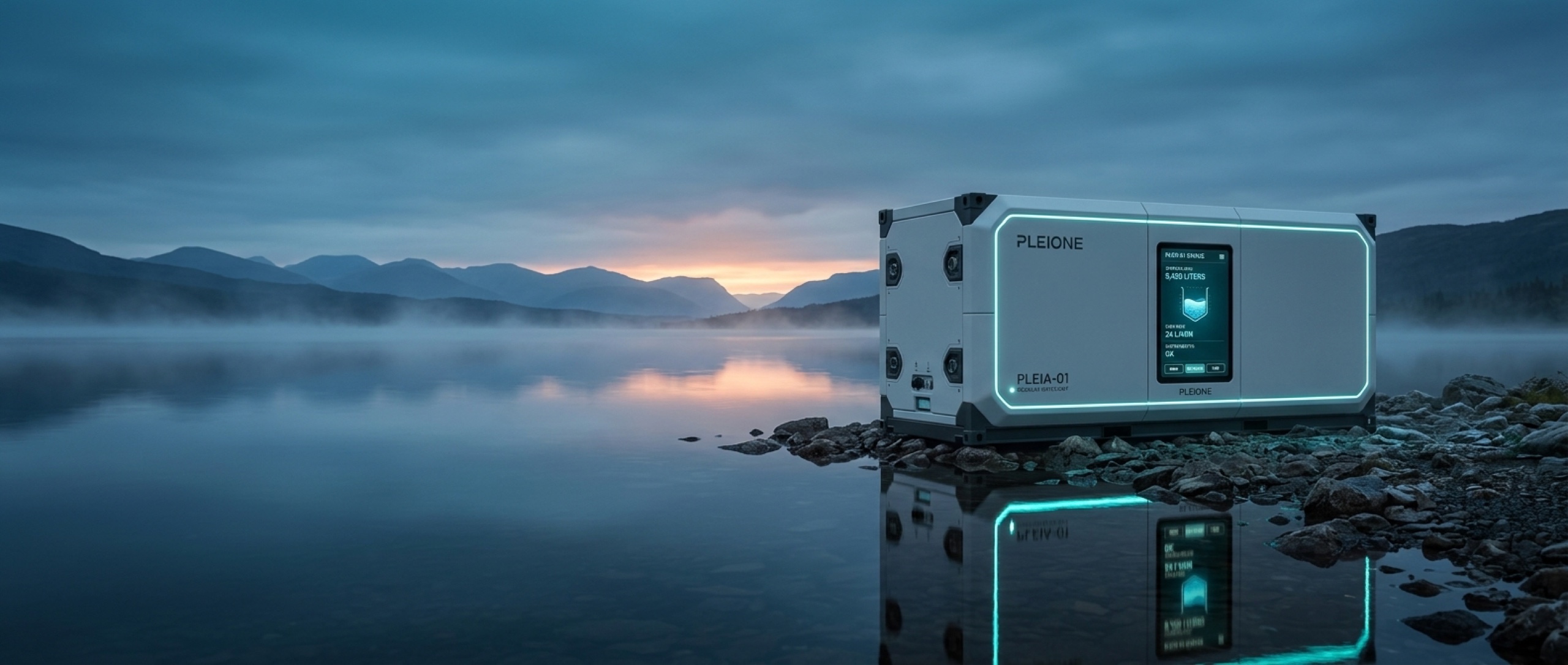
Pleione builds water infrastructure that operates autonomously and proves every litre with a record anyone can verify. Modular units built in weeks, not years. Serviceable anywhere, by anyone.
24/7autonomous operation, no on-site operator required
∞every litre verifiable offline, no trust required
weeksfrom order to running water, not years of construction
SCROLL
02 The real problem
The world has water treatment. It lacks water that stays running.
Why systems fail
Plants get built, celebrated, and abandoned. Roughly a third of rural water systems worldwide are broken at any moment. The bottleneck is not the technology. It is operations: certified operators nobody can recruit, spare parts that take months, and no one watching the system between failures.
Operators are the legal requirement no remote site can staff
Spares arrive by plane, season, or never
Nobody can prove the water was safe yesterday, let alone today
The Pleione answer
Infrastructure that runs itself. Pleia OS operates each unit autonomously within deterministic safety limits, one licensed operator oversees many sites remotely, and every litre is signed into a record anyone can check.
Autonomous operation, human oversight from anywhere
Swap-and-go modules and a printed spares library, fixable by anyone
A verified safety record for every litre delivered
Funders stop paying for plants. They pay for verified water.
Autonomous Water. Infrastructure measured in months between human visits.
The Autonomy Horizon
The verified number of days a Pleia can keep producing safe water before a person must intervene. It is the number we design every unit around, and the number we will publish as measured once units run in the field.
The metric we introduce
Human-intervention hours per 1,000 m³
How much human time it takes to deliver a thousand cubic metres of safe water. Lower is better. Plants are usually judged by what they cost to build; we want them judged by what they cost to keep running.
PLEIA · AUTONOMY TARGETSENGINEERING TARGETS
6months between human visits Pleia 20
12+months between human visits Pleia 40
Same output. Targets for suitable source waters, confirmed by mass balance and field data. Published as measured once deployed units run.
Pleia doesn't just make water. It takes care of the factory that makes the water.
Manufactured like a 2026 company, not a 1980s plant.
Additive manufacturing
Printed enclosures, manifolds and thermal cores. Complex geometries conventional fabrication cannot make, with no tooling capital.
Weeks, not years
No site construction project. Units arrive configured, connect to local source water and power, and start producing.
A printed spares library
Replacement parts printed near the site instead of flown in. Serviceable by local hands with common tools.
06 Meet Pleia™
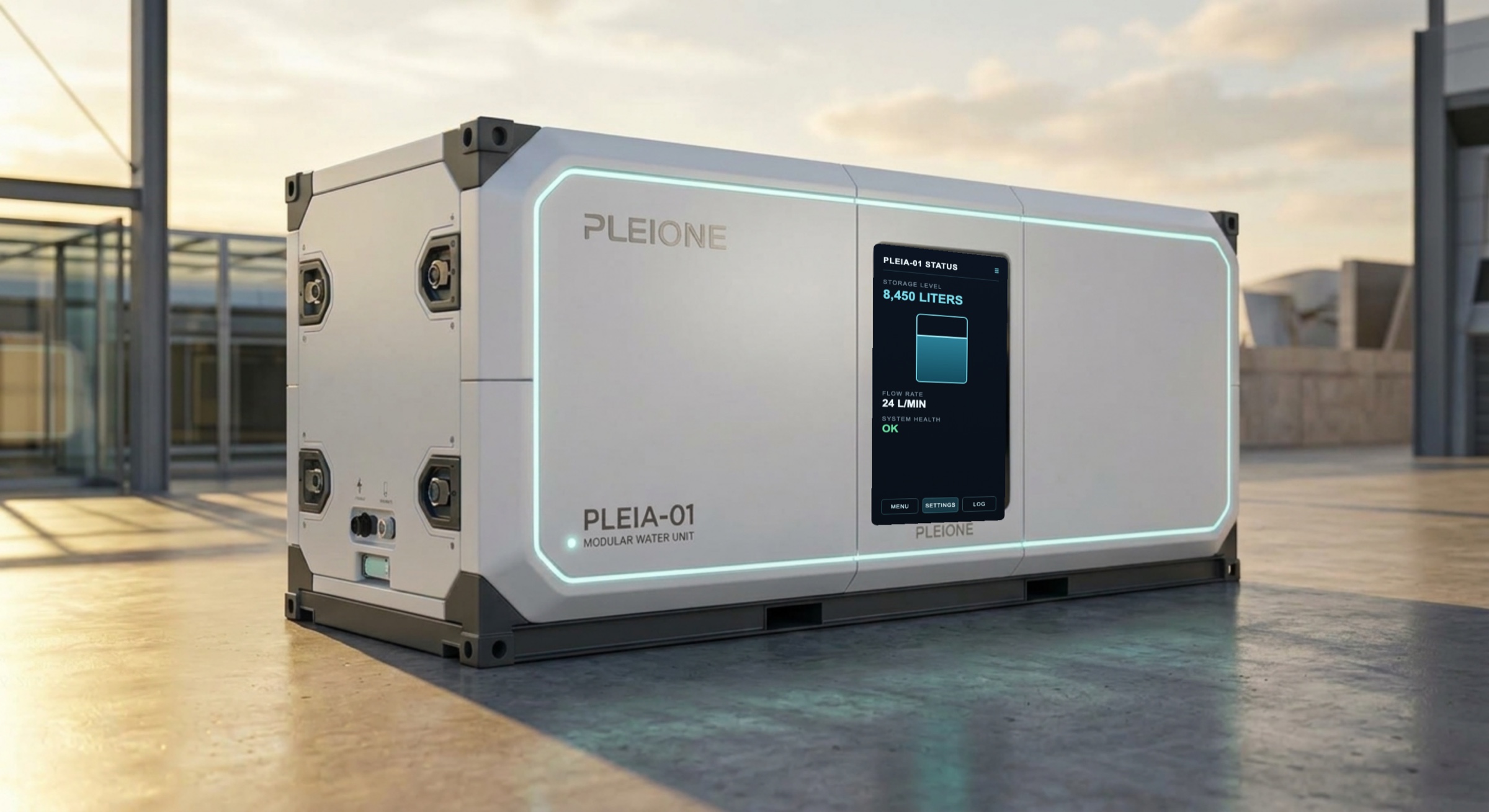
A quiet white box.A complete water plant.
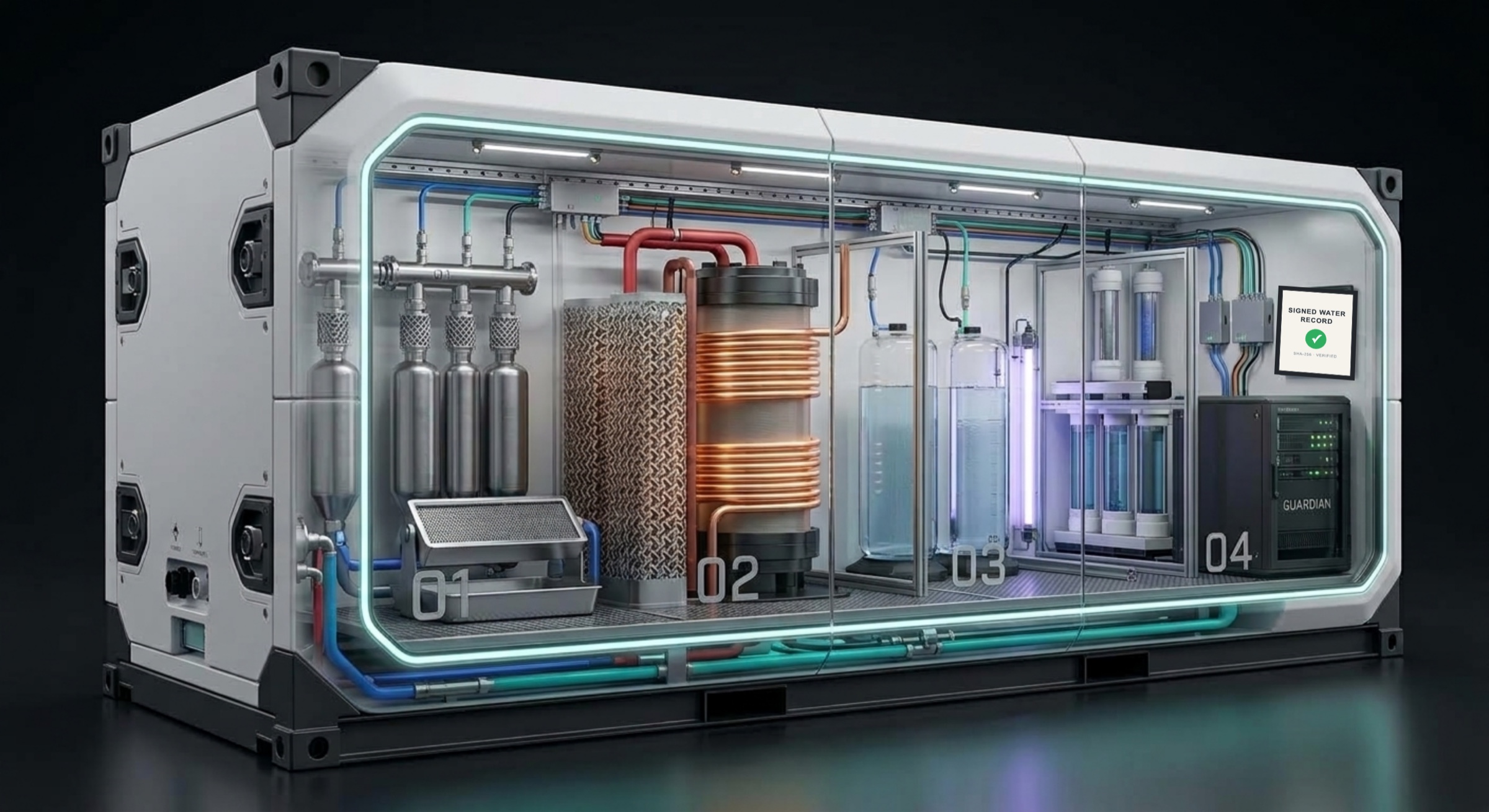
X-RAY · BAYS 01–04
Sized for a standard container. Deployed in days.01 Intake · 02 Thermal core · 03 Recovery · 04 Pleia OS
Concept visualization · design study, not a validated engineering drawing
07 The output you choose
Connect your water. Tell Pleia what you need. Pleia figures out the rest.
01Connect
Water and power. Two hoses and a wire.
02Analyze
Pleia and Pleia OS characterize the water you have.
03Choose
The output you need: potable, irrigation, livestock, cooling, industrial process or reuse.
04Produce
Pleia runs a validated pathway and verifies every litre.
One unit, more than one kind of water
Change the output as needs change.
Drinking water for the camp today, cooling or irrigation water tomorrow, a mix next season. The same Pleia follows the need instead of being rebuilt for it.
Two outputs the same day.
A split stream. Everything passes the shared barriers, then one stream leaves for irrigation, livestock or cooling while the other continues through the extra potable barriers. Each output is verified and recorded separately.
Never treat more than necessary.
Make cooling water when you need cooling water. Less energy, fewer chemicals, longer membrane life and more time between visits.
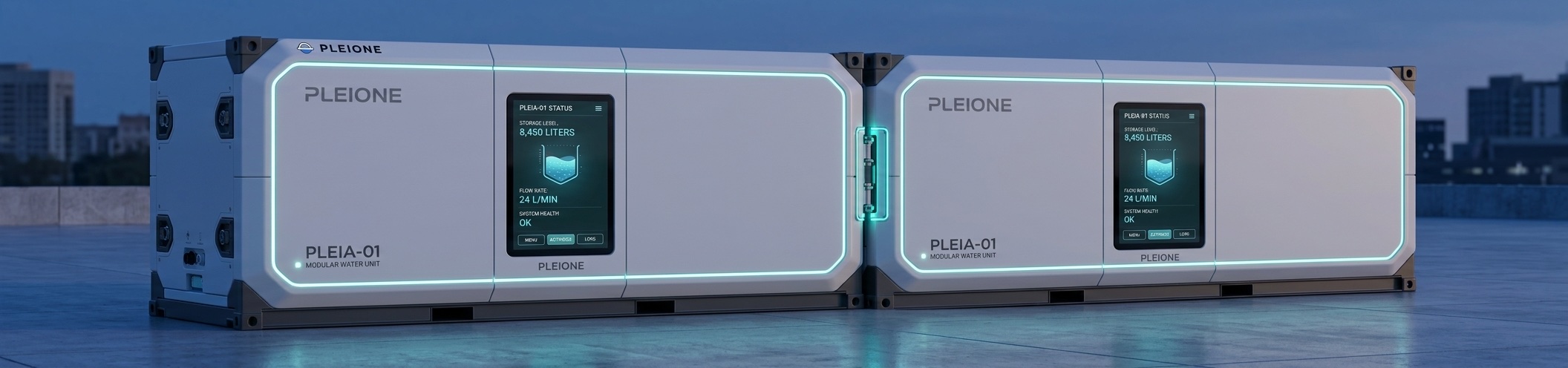
Two Pleias, one water system.
Identical units share the work, not the chemicals, and cooperate on one site. Pleia OS moves production between them as demand changes: potable and irrigation side by side today, all potable in a drought. Buy two identical Pleias. Get one water system that reshapes itself around what your community needs.
PLEIA OS FACE · OUTPUTILLUSTRATIVE
Your waterRiver · turbid surface water
AvailablePotableIrrigationLivestockCooling
Needs a moduleHigh purity
Today · split stream
Potableheld on divert until verified
Irrigationverified · recorded
Illustrative mock of the on-unit screen. Switching to potable is a steward action, never a public button.
Safety rulesPotable only on validated pathways, through a physically separate potable outlet, held on divert until verified.
Pleia 01 ships as one validated configuration first: turbid river to potable, with a provision for a second non-potable output. Other outputs follow field validation.
08 Connect
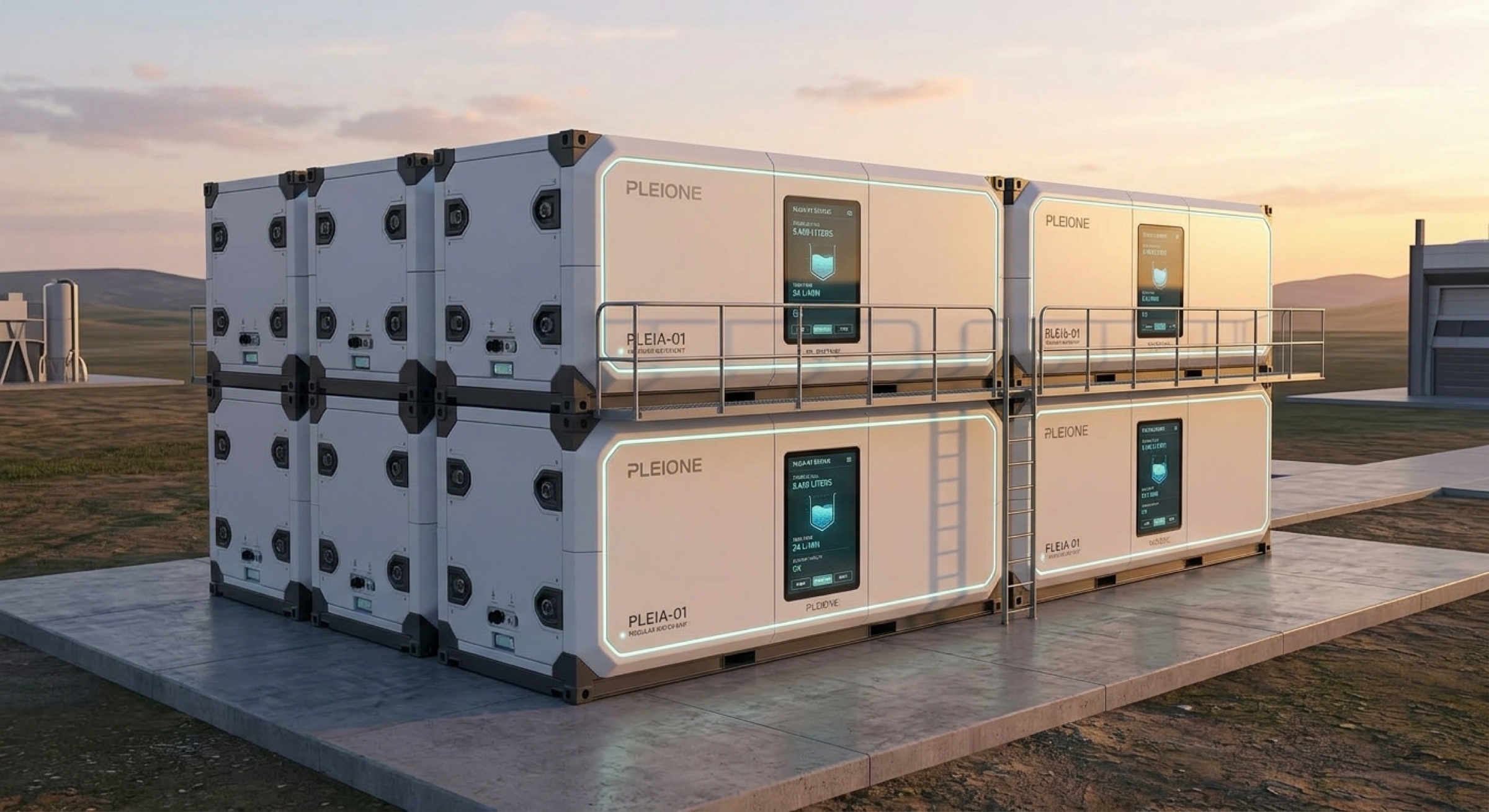
Units dock side by side. One becomes two in an afternoon, sharing water, heat and Pleia OS oversight.
09 Scale
Start with one. Grow into a plant.
Stacked at the corner castings, serviced from a walkway, run as one system by a single remote operator. Capacity grows in units, not construction projects.
1 UNIT→1 ROW→1 PLANT
END OF RECORD — PLEIONE WATER
10 Build with us
Reliable water, anywhere. Provable everywhere.
We are looking for pilot hosts, deployment partners and funders who pay for outcomes. If reliable, verifiable water matters where you operate, talk to us.