THE UNIT

Pleia™

A complete water plant in a container footprint. It treats, recovers, runs itself, and signs a record for every litre.

Footprint fits a standard containerOperation autonomous · remote oversightExpansion docks sideways · stacks verticallyEvidence every litre signed · verifiable offline
01 Sources

It drinks what the site has.

Heat is the energy, not the source. Pleia is configured per site around whatever water exists, and the physics that can be recovered from it.

Wastewater

The site's own grey and process water, treated for reuse so less is drawn from supply.

Brackish & contaminated

Local ground or surface water, upgraded through heat-driven membrane distillation.

Air

Sorbent capture of atmospheric moisture where climate allows, released with low-grade heat.

Waste heat

The energy input: reject heat from generators and equipment drives the recovery train instead of new load.

04 The Pleia™ unit

A resource reactor. Not a black box.

20 ft · fits a standard sea containerWASTEWATERBRINE / SALTAIRINTAKEMEMBRANE DISTILLATIONWASTE HEATRECOVERYVERIFYPOTABLE + NON-POTABLEVERIFIED WATER RECORDsha-256 · 9f3a…8ac6
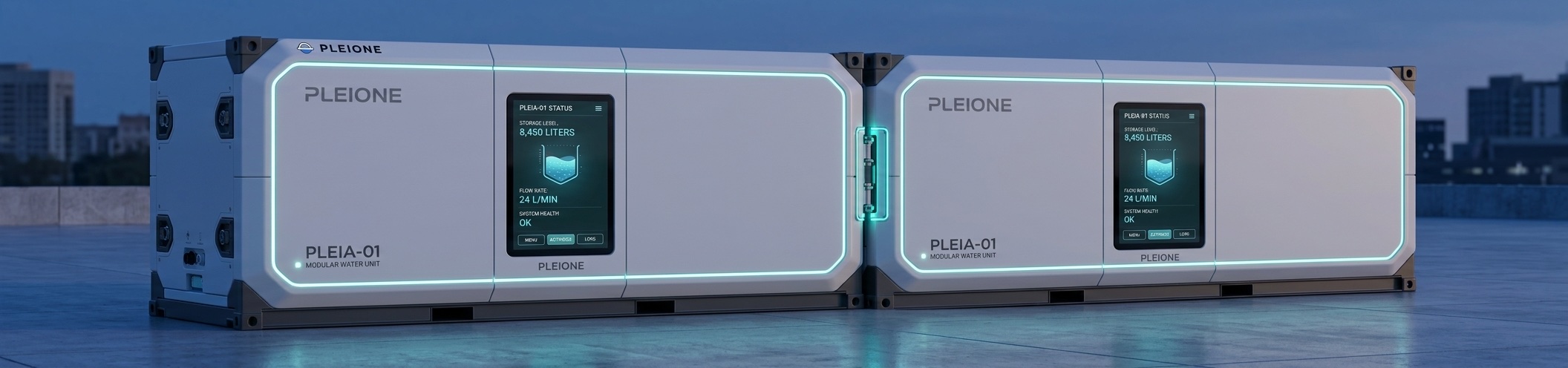
Two Pleia units docked side by side
03 Connect

Standardized docking interfaces join units into one hydraulic and data system. One becomes two in an afternoon.

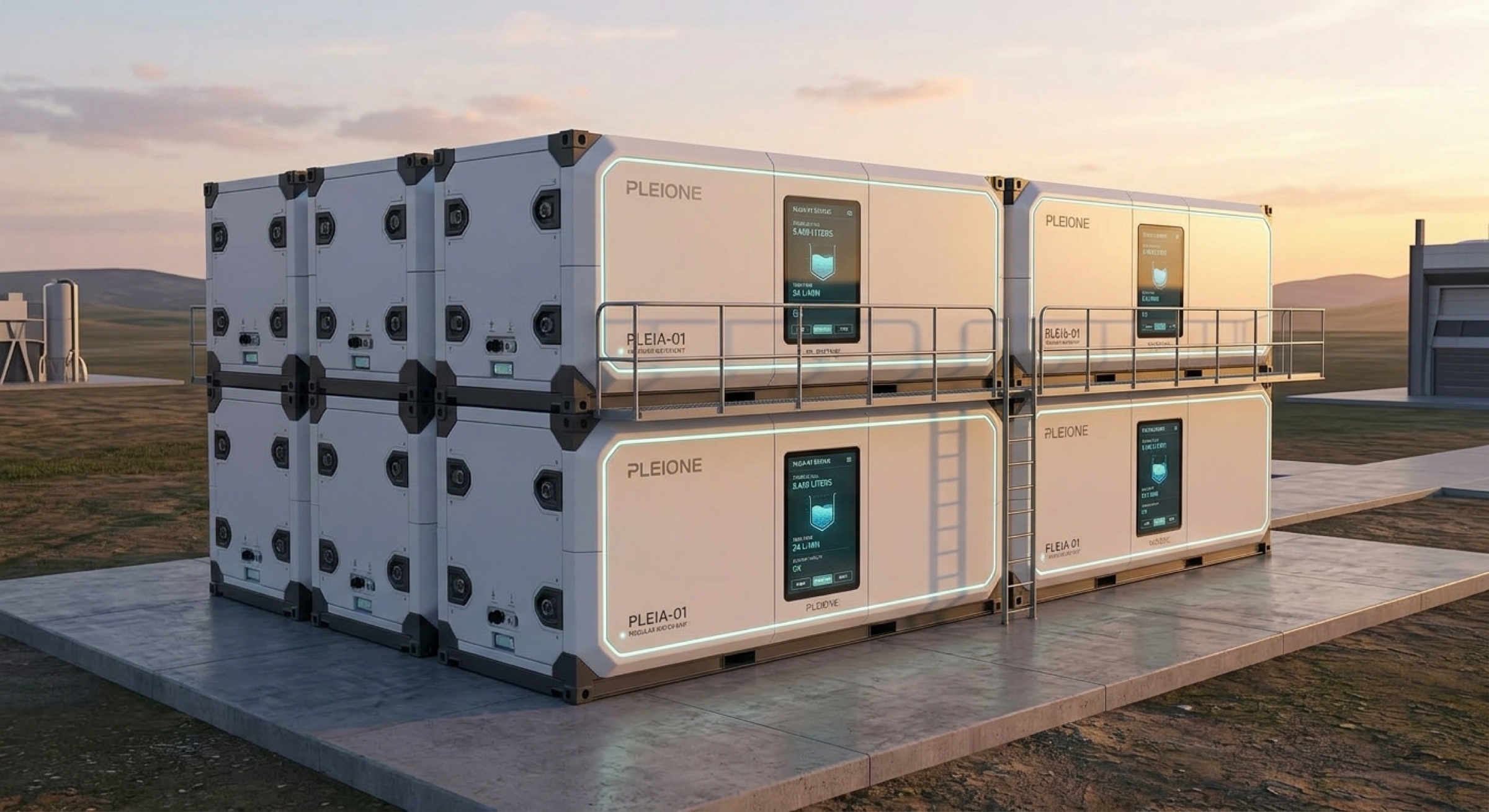
Six Pleia units stacked as a modular plant
04 Scale

Reinforced corner castings stack rows into a plant, serviced from a walkway, run by one remote operator.

Concept visualizations · design study, not validated engineering drawings
05 The line

Same water. Longer between visits.

Both units make the same standardized output. What changes is how long they can go without a person. Pleia 40 spends its extra volume on reserves and redundancy, not on more water.

Pleia 20

Standard autonomy
~6 months between resupplyEngineering target
  • Same standardized output as Pleia 40
  • Full treatment train, Pleia OS and the Verified Water Record
  • For sites with a regular service route

Pleia 40

Extended autonomy
12+ months between resupplyEngineering target
  • Same standardized output as Pleia 20
  • Consumable reserves: salt, media, cartridges
  • Redundancy: duty and standby pumps, twin UV, redundant compliance sensors
  • An on-board spares store

Engineering targets for suitable source waters, confirmed by mass balance and field data.

CLUSTER

Pleia Cluster

Identical Pleias that specialize when useful and cooperate as one water system. Pleia OS moves production between units as demand changes: two units might make 25,000 L of potable and 25,000 L of irrigation water today, and 50,000 L of potable in a drought (illustrative).

The units share the work, not the chemicals. Pleia OS shifts which unit makes which water based on each unit's reserves, and each unit carries a full horizon of its own reserves, so nobody has to move anything between visits. No extra hardware.

The site shares one intake and pre-treatment, with separate potable and non-potable storage. Each unit runs on its own, so one unit down does not stop the site. Grow from 2 units to 50.

Buy two identical Pleias. Get one water system that reshapes itself around what your community needs.

FORM

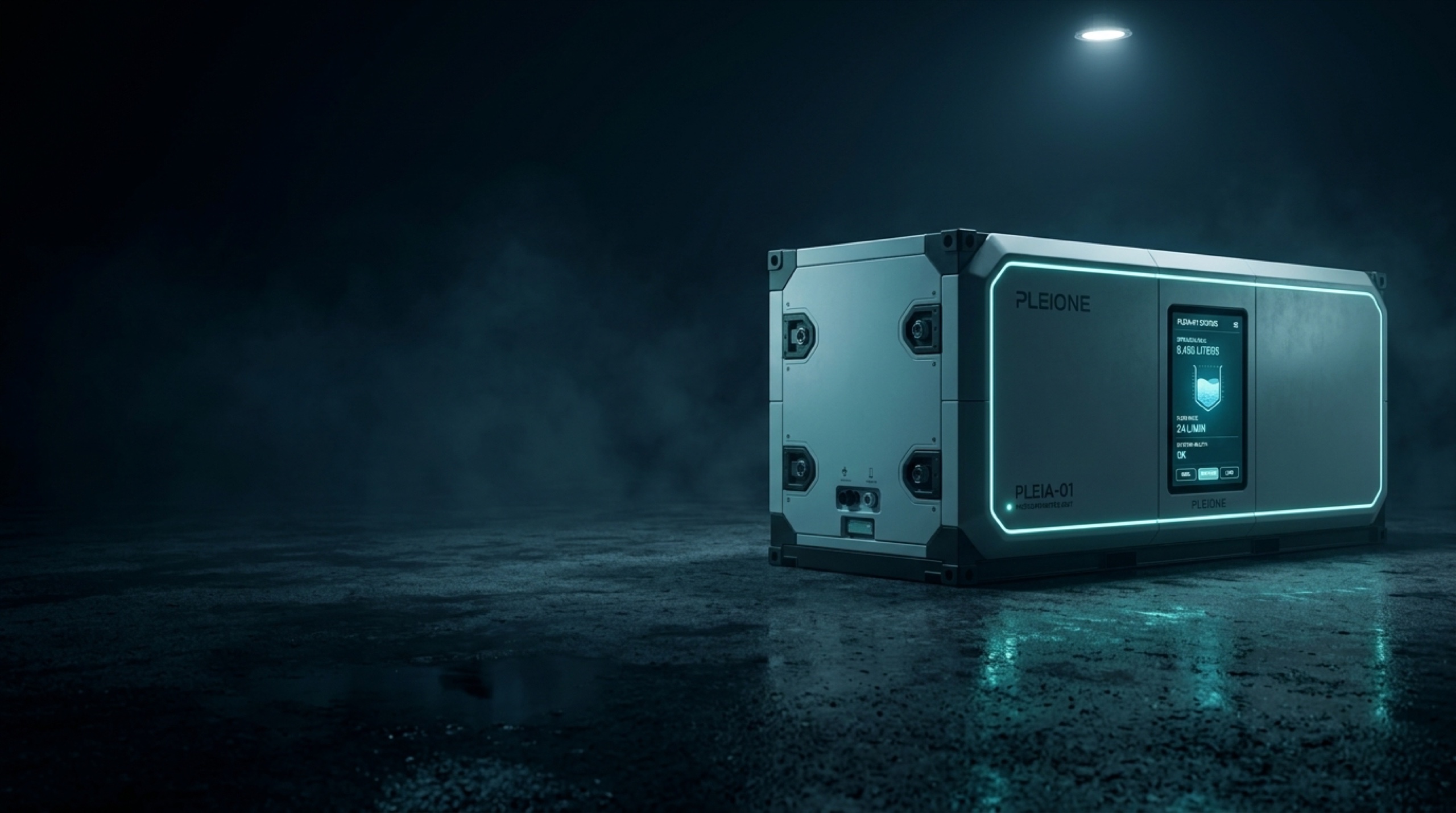
Ships as a container.

The production line is a Pleione-designed body on a certified ISO frame, so every unit moves by ship, rail or truck like any container, and arrives looking like Pleia.

Standardized for global transport. Designed as Pleia.
06 The platform

One platform. Any water. The output you choose.

Every Pleia shares the same core. What changes from site to site is the media in one standard bay, and the capability modules added for harder water or a different job.

Every unit

Pleia Core

The part that never changes: hydraulics, power, controls, sensing, safety, dosing, cleaning and Pleia OS.

  • Same core in every Pleia
  • Pleia OS operates it within hard safety limits
  • Every output verified and recorded
Configured per source

Universal Media Bay

One standard vessel with swappable, identified media, matched to what is in the water.

  • Arsenic
  • Fluoride
  • Nitrate
  • Metals
  • PFAS-specific media
Future modules

Capability modules

Larger add-ons for different processes. Seawater is a module, not the core.

  • Seawater desalination
  • Biological wastewater
  • Mining and acid drainage
  • High purity
  • Resource recovery

Pleia 01 ships as one validated configuration first: turbid river to potable, with a provision for a second non-potable output. Media options and capability modules follow field validation.

Later, Pleia Compatible: a module standard other builders can design to.

07 Manufacturing

Built like a 2026 company.

PRINTAdditive cores

Printed enclosures, manifolds and thermal lattice cores. Complex geometries with no tooling capital, so the design can iterate weekly.

ASSEMBLEWeeks, not years

Proven wet-side components in a standardized frame. Units arrive configured and connect on site in days.

SERVICEThe printed spares library

Replacement parts printed near the site instead of flown in. Fixable by local hands with common tools.

08 Status, stated plainly

The spec sheet we will not fake.

Unit architectureDesigned · fabricator-quote level
Pleia OS operating layerBuilt · running on real and simulated feeds
Verified Water RecordBuilt · verifiable offline
OutputDesign target ~25,000 L/day per unit · published as measured once Pleia 01 runs
Unattended operationPleia 20 ~6 months · Pleia 40 12+ months between resupply · engineering targets · local steward as hands, guided by Pleia OS
ConsumablesChlorine made on site from salt · parallel filter banks switched by valve · year-sized stores
Thermal recovery trainIn engineering and lab validation
Recovery rate · cost per m³ · membrane lifeNot yet measured

We publish performance when it is measured on a Pleia unit, and not before. That discipline is the same one that signs the water record.

Pleia 01 needs a first site.

We are selecting pilot hosts and deployment partners now. Measurement-first, low-risk, and verifiable from day one.